Showing posts with label rnaseq. Show all posts

Sunday, 12 November 2017

Edwards Lab at #ABACBS2017 and COMBINE

The Australian Bioinformatics And Computational Biology Society (ABACBS) 2017 Conference is here and the lab has four posters this year. If you are attending this year, come visit us or come at chat at one of the evening events. If not, we’ll stick them up on the lab webpage and/or Australian Bioinformatics And Computational Biology Society Conference F1000Research channel - tweet or email if you have any questions.

Gus and Kirsti will also be presenting their work orally at the COMBINE student symposium the day before the main conference.

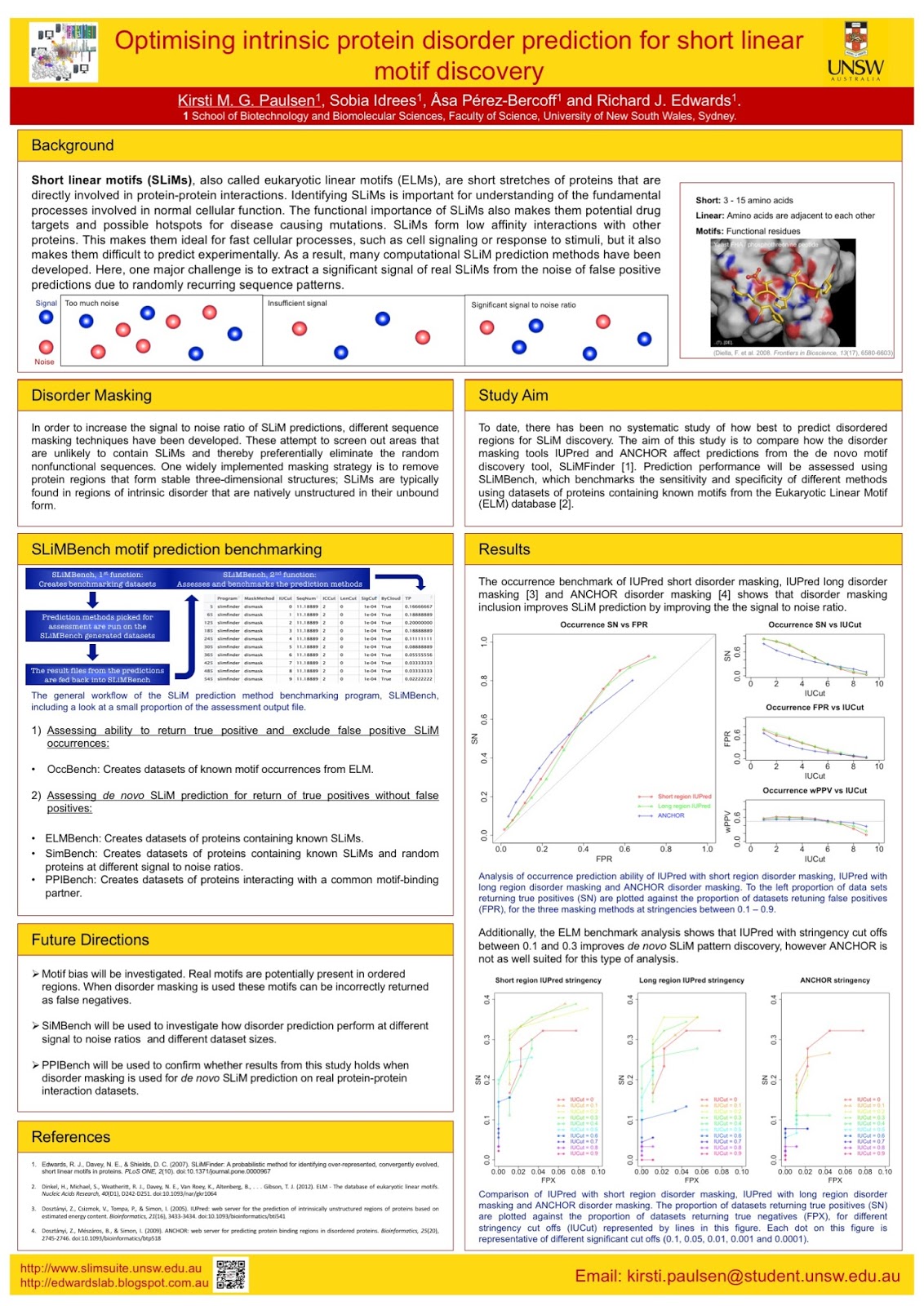
  • Tue 14th Nov Poster #9: Optimising intrinsic protein disorder prediction for short linear motif discovery. Kirsti Paulsen, Sobia Idrees, Åsa Pérez-Bercoff and Richard Edwards. (ABACBS2017 Abstract #51)

  • Tue 14th Nov Poster #11: Multi-omic Characterisation of a Novel Xylose Metabolising Strain of Saccharomyces cerevisiae. Gustave Severin, Åsa Pérez-Bercoff, Psyche Arcenal, Anna Sophia Grobler, Philip J. L. Bell, Paul V. Attfield and Richard J. Edwards. (ABACBS2017 Abstract #56)

  • Wed 15th Nov Poster #2: Investigating the evolution of complex novel traits using whole genome sequencing and molecular palaeontology. Åsa Pérez-Bercoff, Psyche Arcenal, Anna Sophia Grobler, Philip J. L. Bell, Paul V. Attfield and Richard J. Edwards. (ABACBS2017 Abstract #55)

  • Wed 15th Nov Poster #5: PacBio sequencing, de novo assembly and haplotype phasing of diploid yeast strains. Richard J. Edwards, Åsa Pérez-Bercoff, Tonia Russell, Paul V. Attfield and Philip J.L. Bell. (ABACBS2017 Abstract #59)

Click on the thumbnails below for a preview:

Tuesday, 15 August 2017

High risk human papilloma viruses (HPVs) are present in benign prostate tissues before development of HPV associated prostate cancer

Glenn WK, Ngan CC, Amos TG, Edwards RJ, Swift J, Lutze-Mann L, Shang F, Whitaker NJ & Lawson JS (2017): High risk human papilloma viruses (HPVs) are present in benign prostate tissues before development of HPV associated prostate cancer. Infectious Agents and Cancer 12:46.

Abstract

Background. Although high risk HPVs are associated with an increased risk of prostate cancer it is not known if they have a causal role. The purpose of this study is to investigate the potential role of human papilloma viruses (HPVs) in prostate cancer. The aims are (i) to investigate the presence and confirm the identity of high risk HPVs in benign prostate tissues prior to the development of HPV positive prostate cancer in the same patients, and (ii) to determine if HPVs are biologically active.

Methods. We used polymerase chain reaction (PCR) to identify HPVs in specimens from 52 Australian men with benign prostate biopsies who 1 to 10 years later developed prostate cancer. Immunohistochemistry (IHC) was used to assess the expression of HPV E7 oncoproteins, cytokeratin and prostate specific antigen (PSA).

We used RNASeq data from The Cancer Genome Atlas (TCGA) to identify possible HPV RNA sequences in prostate cancer.

Results. HPV screening using standard PCR was conducted on 28 of the 52 sets of benign and later prostate cancers. HPV L1 genes were identified in 13 (46%) benign and 8 (29%) of 28 later prostate cancers in the same patients. HPV E7 genes were identified in 23 (82%) benign and 19 (68%) of 28 subsequent prostate cancers in the same patients. The same HPV types were present in both the benign and subsequent prostate cancers in 9 sets of specimens. HPV type 16 was identified in 15% of benign and 3% of prostate cancers. HPV type 18 was identified in 26% of benign and 16% of prostate cancers. Small numbers of HPV types 45, 47, 76 and 115 were also identified.

High confidence RNA-Seq evidence for high risk HPV types 16 and 18 was identified in 12 (2%) of the 502 TCGA prostate cancer transcriptomes.

High risk HPV E7 oncoprotein was positively expressed in 23 (82%) of 28 benign prostate specimens but only in 8 (29%) of 28 of the later prostate cancer specimens. This difference is statistically significant (p = 0.001). Prostate specific antigen (PSA) was more highly expressed in 26 (50%) of 52 prostate cancer specimens as compared to prior benign prostate specimens in the same patients.

Conclusions. High risk HPVs are present in benign prostate tissues prior to the development of HPV positive prostate cancer. There is a significantly higher expression of HPV E7 oncoproteins in benign prostate tissues as compared to late prostate cancer that subsequently developed in the same patients. This observation suggests that HPV oncogenic activity is an early phenomenon in a majority of prostate oncogenesis. TCGA RNA-Seq data suggests that HPV is biologically active in some prostate tumour samples.

Emeritus Professor Jim Lawson has this to say about the study:

“Human papilloma viruses are the cause of cervical cancer in women. These viruses are sexually transmitted. Infections by human papilloma viruses can be prevented by effective vaccines including the Australian developed Gardosil.

Scientists from the University of New South Wales, Sydney, Australia, have identified high risk human papilloma viruses in normal prostate tissues 2 to 12 years before the development of human papilloma virus positive prostate cancer. While the scientists do not claim this is evidence that human papilloma viruses are a direct cause of prostate cancer, they advise that it is prudent for both men and women to act with caution.

Human papilloma viruses are present in semen in over 15% of men and can be readily transmitted during sexual activities.

Vaccines such as the Australian developed Gardosil, are safe and effective in preventing infections by human papilloma viruses. The University of New South Wales scientists strongly encourage both young men and women to prevent human papilloma virus infections by vaccination at a young age.”

Friday, 19 August 2016

Plant adaptation or acclimation to rising CO2? Insight from first multigenerational RNA-Seq transcriptome

Watson-Lazowski A, Lin Y, Miglietta F, Edwards RJ, Chapman MA & Taylor G (2016): Plant adaptation or acclimation to rising CO2? Insight from first multigenerational RNA-Seq transcriptome. Glob Chang Biol. Adv. access. doi: 10.1111/gcb.13322

Abstract

Atmospheric carbon dioxide (CO2 ) directly determines the rate of plant photosynthesis and indirectly effects plant productivity and fitness and may therefore act as a selective pressure driving evolution, but evidence to support this contention is sparse. Using Plantago lanceolata L. seed collected from a naturally high CO2 spring and adjacent ambient CO2 control site, we investigated multigenerational response to future, elevated atmospheric CO2 . Plants were grown in either ambient or elevated CO2 (700 μmol mol-1 ), enabling for the first time, characterization of the functional and population genomics of plant acclimation and adaptation to elevated CO2 . This revealed that spring and control plants differed significantly in phenotypic plasticity for traits underpinning fitness including above-ground biomass, leaf size, epidermal cell size and number and stomatal density and index. Gene expression responses to elevated CO2 (acclimation) were modest [33-131 genes differentially expressed (DE)], whilst those between control and spring plants (adaptation) were considerably larger (689-853 DE genes). In contrast, population genomic analysis showed that genetic differentiation between spring and control plants was close to zero, with no fixed differences, suggesting that plants are adapted to their native CO2 environment at the level of gene expression. An unusual phenotype of increased stomatal index in spring but not control plants in elevated CO2 correlated with altered expression of stomatal patterning genes between spring and control plants for three loci (YODA, CDKB1;1 and SCRM2) and between ambient and elevated CO2 for four loci (ER, YODA, MYB88 and BCA1). We propose that the two positive regulators of stomatal number (SCRM2) and CDKB1;1 when upregulated act as key controllers of stomatal adaptation to elevated CO2 . Combined with significant transcriptome reprogramming of photosynthetic and dark respiration and enhanced growth in spring plants, we have identified the potential basis of plant adaptation to high CO2 likely to occur over coming decades.

PMID: 27539677

Monday, 20 June 2016

Transcriptome analysis of human brain tissue identifies reduced expression of complement complex C1Q Genes in Rett syndrome

Lin P, Nicholls L, Assareh H, Fang Z, Amos TG, Edwards RJ, Assareh AA, Voineagu I (2016): Transcriptome analysis of human brain tissue identifies reduced expression of complement complex C1Q Genes in Rett syndrome. BMC Genomics 17(1):427. doi: 10.1186/s12864-016-2746-7.

Abstract

BACKGROUND: MECP2, the gene mutated in the majority of Rett syndrome cases, is a transcriptional regulator that can activate or repress transcription. Although the transcription regulatory function of MECP2 has been known for over a decade, it remains unclear how transcriptional dysregulation leads to the neurodevelopmental disorder. Notably, little convergence was previously observed between the genes abnormally expressed in the brain of Rett syndrome mouse models and those identified in human studies.

METHODS: Here we carried out a comprehensive transcriptome analysis of human brain tissue from Rett syndrome brain using both RNA-seq and microarrays.

RESULTS: We identified over two hundred differentially expressed genes, and identified the complement C1Q complex genes (C1QA, C1QB and C1QC) as a point of convergence between gene expression changes in human and mouse Rett syndrome brain.

CONCLUSIONS: The results of our study support a role for alterations in the expression level of C1Q complex genes in RTT pathogenesis.

PMID: 27267200

Tuesday, 10 September 2013

iOES Poster: Using Next Generation Sequencing to Understand Plant Acclimation and Adaptation to the Changing Environment

Alex Watson-Lazowski, Yunan Lin, Jennifer DeWoody, Richard Edwards and Gail Taylor.

1st International Environmental Omics Synthesis (iEOS) Conference, Cardiff, UK (Sept 11-13, 2013). Poster EcO-15.

Abstract:

Plant adaptation to elevated atmospheric carbon dioxide (CO2) is of great interest, as the concentration of this gas in the atmosphere has risen by more than 30% to 388 μmol mol-1 since the industrial revolution. On average there has been a rise of 3 ppm per year. Plant fossil samples suggest that atmospheric CO2 may be acting as a selective agent driving evolution, but limited evidence is available to support this idea for plants subjected to future predicted concentrations. Studying evolutionary responses to this aspect of environmental change is difficult, but here we use a CO2 spring site where plants have been exposed for multiple generations to concentrations of CO2 predicted for 2050. From this, detailed phenotyping data was collected, including data for stomatal patterning. Considerable evidence exists to show that stomatal numbers have declined across geological time and that this is linked to CO2 concentration, but few CO2-sensitive stomatal patterning genes have ever been identified. When grown under elevated CO2 concentrations P. lanceolata (the narrow leaf plantain), seeds collected from the spring site showed a counter-intuitive change in stomatal index and density. Here, in this non- model plant we have investigated the gene expression changes underlying this stomatal patterning response to elevated CO2.

RNA-Seq allows for in depth analysis of plant species with no previous information required, enabling rapid evaluation of any of novel plant acclimations and adaptions. Using this approach we have identified a set of novel genes for stomatal patterning in high CO2 and confirmed previously observed acclimation responses.

RNA-Seq refers to the use of high-throughput deep-sequencing technologies to sequence cDNA in order to get information about the transcriptome of a given biological sample.