Showing posts with label @kpaulsen. Show all posts

Wednesday, 28 November 2018

EdwardsLab at #ABACBS2018

For those who missed it, there’s a (slightly old) poster version of my ABACBS 2018 talk - Sequencing snakes: Pseudodiploid pseudo-long-read whole genome sequencing and assembly of Pseudonaja textilis (eastern brown snake) and Notechis scutatus (mainland tiger snake). If anything in the talk (except the repeat stuff) looks useful to you, this is a citeable poster:

Edwards RJ et al. Pseudodiploid pseudo-long-read whole genome sequencing and assembly of Pseudonaja textilis (eastern brown snake) and Notechis scutatus (mainland tiger snake) [version 1; not peer reviewed]. F1000Research 2018, 7:753 (poster) (doi: 10.7490/f1000research.1115550.1)

We’re still developing the genome size prediction and BUSCO comparison/compilation tools, so get in touch if either of these look useful to you.

ABACBS2018 Posters

We have three lab posters in Poster session 2 this morning:

  • Poster #16. Åsa Pérez-Bercoff, Using structural variant detection to resolve difficult regions of a genome assembly.

  • Poster #21. Kirsti Paulsen, Optimising intrinsic protein disorder prediction for short linear motif discovery.

  • Poster #26. Katarina Stuart, Evolution in invasive populations: using genomics to reveal drivers of invasion success in the Australian European starling (Sturnus vulgaris) introduction across Australia.

Also check out the posters of our UNSW neighbours from the Wilkins lab:

  • Poster #29. Chi Nam Ignatius (Igy) Pang, Benchmarking Protein Correlation Profiling datasets against reference protein complexes: case studies in S. cerevisiae.

  • Poster #44. Susan Corley, QuantSeq 3’ sequencing paired with Salmon quantification provides a fast reliable approach for high throughput transcriptomic analysis.

  • Poster #49. Xabier Vázquez-Campos, OTUreporter: an automated pipeline for the analysis and report of amplicon sequencing data.

Friday, 15 June 2018

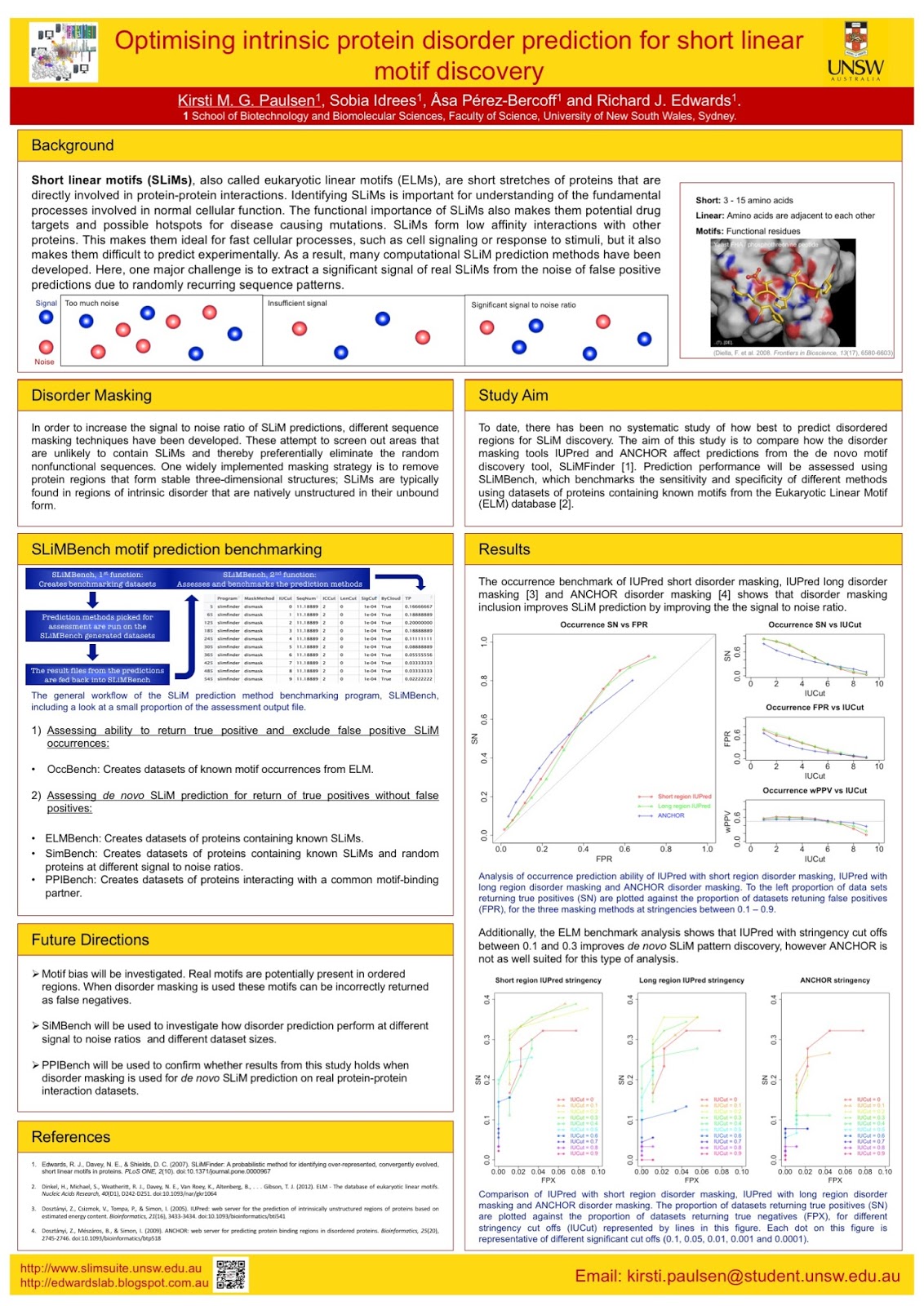
Optimising intrinsic protein disorder prediction for short linear motif discovery

Kirsti M G Paulsen, Norman E Davey, Sobia Idrees, Åsa Pérez-Bercoff & Richard J Edwards.

This work was presented at the Sydney Bioinformatics Research Symposium 2018. (Abstract below.) Click on thumbnail for full resolution PDF.

Abstract

Short linear motifs (SLiMs) are short stretches of proteins that are directly involved in protein-protein interactions (PPI). Identifying SLiMs is important for understanding fundamental processes involved in normal cellular function. SLiMs are commonly only 3 - 10 amino acids in length and form low affinity interactions. This makes them ideal for fast cellular processes, such as cell signalling or response to stimuli, but also difficult to predict experimentally. As a result, many computational SLiM prediction methods have been developed. In order to increase the signal to noise ratio of SLiM predictions, different sequence masking techniques have been developed. These attempt to screen out areas that are unlikely to contain SLiMs and thereby preferentially eliminate the random nonfunctional sequences. One widely implemented masking strategy is to remove protein regions that form stable three-dimensional structures; SLiMs are typically found in regions of intrinsic disorder that are natively unstructured in their unbound form. To date, there has been no systematic study of how best to predict intrinsic disordered protein regions for SLiM discovery. Poor quality predictions will not have the desired noise-removal, while over-stringent masking will remove too many true positives. The aim of this study is to compare how ten different disorder prediction methods affect SLiM occurrence prediction and to identify the best method and settings for this purpose. The disorder prediction scores for each residue in the human proteome was obtained from the MobiDB database. Further, this study aims to investigate whether the optimal disorder masking settings for occurrence SLiM prediction are the same for de novo SLiM prediction and for identification of SLiM mediated PPIs.

Thursday, 14 June 2018

Edwards lab at #SBRS2018

Come visit our posters at the Sydney Bioinformatics Research Symposium 2018! Details and high res versions to follow...

Sunday, 12 November 2017

Edwards Lab at #ABACBS2017 and COMBINE

The Australian Bioinformatics And Computational Biology Society (ABACBS) 2017 Conference is here and the lab has four posters this year. If you are attending this year, come visit us or come at chat at one of the evening events. If not, we’ll stick them up on the lab webpage and/or Australian Bioinformatics And Computational Biology Society Conference F1000Research channel - tweet or email if you have any questions.

Gus and Kirsti will also be presenting their work orally at the COMBINE student symposium the day before the main conference.

  • Tue 14th Nov Poster #9: Optimising intrinsic protein disorder prediction for short linear motif discovery. Kirsti Paulsen, Sobia Idrees, Åsa Pérez-Bercoff and Richard Edwards. (ABACBS2017 Abstract #51)

  • Tue 14th Nov Poster #11: Multi-omic Characterisation of a Novel Xylose Metabolising Strain of Saccharomyces cerevisiae. Gustave Severin, Åsa Pérez-Bercoff, Psyche Arcenal, Anna Sophia Grobler, Philip J. L. Bell, Paul V. Attfield and Richard J. Edwards. (ABACBS2017 Abstract #56)

  • Wed 15th Nov Poster #2: Investigating the evolution of complex novel traits using whole genome sequencing and molecular palaeontology. Åsa Pérez-Bercoff, Psyche Arcenal, Anna Sophia Grobler, Philip J. L. Bell, Paul V. Attfield and Richard J. Edwards. (ABACBS2017 Abstract #55)

  • Wed 15th Nov Poster #5: PacBio sequencing, de novo assembly and haplotype phasing of diploid yeast strains. Richard J. Edwards, Åsa Pérez-Bercoff, Tonia Russell, Paul V. Attfield and Philip J.L. Bell. (ABACBS2017 Abstract #59)

Click on the thumbnails below for a preview:

Friday, 21 July 2017

Kirsti Paulsen (MPhil student)

Kirsti Paulsen graduated with distinction from UNSW with a Bachelor of Science, majoring in Genetics. She started in the Edwards Lab as an MPhil student in July 2017. Kirsti’s project is evaluating the use of intrinsic disorder predictors for short linear motif discovery.

[LinkedIn]